
5 AI Mistakes Small Businesses Make
Most small businesses stumble with AI in year one for the same fixable reasons. Here are the five most common mistakes and how to sidestep each one.
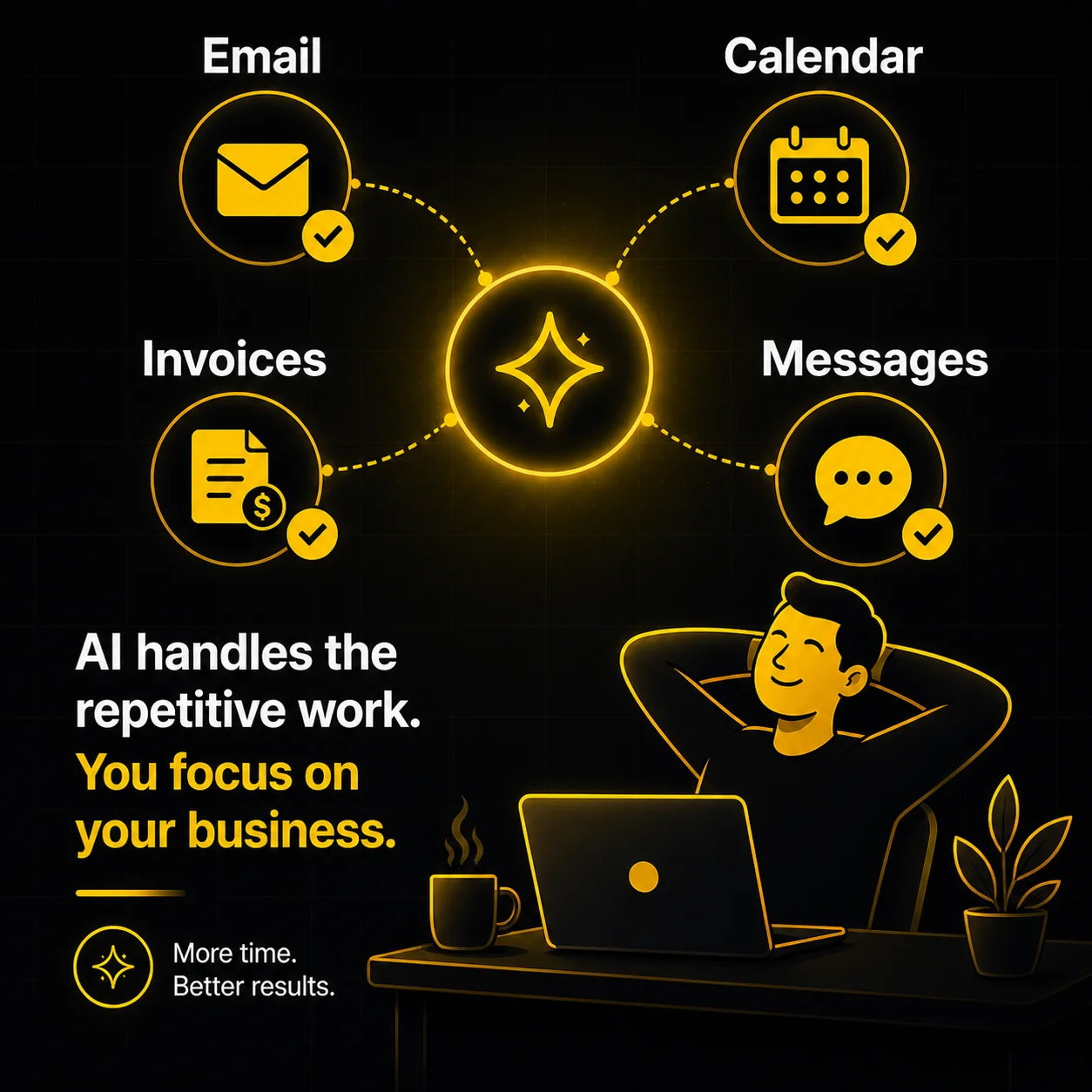
Getting started with AI is exciting. The tools are more accessible than ever, the price points have dropped dramatically, and the promise of saving time and winning customers is very real. But for every small business that finds its footing quickly, several others spin their wheels for months before seeing any return. The difference almost always comes down to the same five mistakes made in year one.
None of these mistakes are catastrophic, and none of them require a technical background to fix. They just require a clearer plan before you start clicking "subscribe."
Mistake 1: Starting With a Tool Instead of a Problem
The most common mistake is choosing an AI tool because it looked impressive at a conference or showed up in your inbox, then trying to figure out what to do with it afterward. This is backwards.
The right starting point is always a specific business problem: a process that eats too much time, a customer question your team answers fifty times a week, a report that takes hours to pull together. When you start with the problem, the right tool becomes obvious. When you start with the tool, you end up paying for software that nobody uses.
Before you sign up for anything, write one sentence describing the outcome you want. "I want to reduce the time my team spends on first response customer emails by half." That sentence becomes your filter for every AI conversation that follows.
Mistake 2: Expecting AI to Run Without Guardrails
AI tools, including AI customer service and AI marketing tools, are genuinely powerful. They are also genuinely imperfect. Businesses that treat an AI agent like a fully autonomous employee in the first month almost always run into trouble, whether that means a chatbot giving a customer wrong pricing information or an AI writing tool publishing content that does not match the brand voice.
A practical AI automation for business looks less like "set it and forget it" and more like a well supervised intern. You build in a review step. You define what the AI is allowed to say and what it must escalate. You check the outputs weekly at first, then monthly as confidence grows.
McKinsey research on AI adoption consistently finds that companies with clear human oversight built into their AI workflows report higher satisfaction and fewer costly errors. You can explore their findings on McKinsey's QuantumBlack insights hub.
Mistake 3: Underestimating the Data Problem
AI is only as useful as the information you feed it. This is the quiet reason so many small business AI pilots fizzle. The business launches a tool, then realizes their customer data lives in three different spreadsheets, their product descriptions are inconsistent, and nobody has cleaned their contact list in two years.
You do not need a data warehouse (a central storage system for all your business data) to get started, but you do need to be honest about what data you actually have and how clean it is. Here is a quick self check before any AI project:
- Is the data you plan to use stored in one place, or scattered across multiple tools?
- Is it updated regularly, or does it go stale quickly?
- Does everyone on your team use the same naming conventions, or does "New York" appear as "NY," "New York," and "NYC" in the same file?
Spending two weeks organizing your data before launching an AI project will save you two months of frustration afterward. This is exactly the kind of work that good data consulting services help businesses do efficiently.
Mistake 4: Trying to Automate Everything at Once
Ambition is good. Trying to automate your marketing, your customer service, your invoicing, and your inventory in the same quarter is a recipe for a team that feels overwhelmed and a business that has no idea which change caused which result.
The businesses that build lasting competitive advantage with AI pick one workflow, run it for sixty to ninety days, measure the result, and then move to the next. This approach keeps your team from burning out, makes it easy to spot problems early, and gives you real data to share with stakeholders about whether the investment is working.
A useful sequence for most small businesses looks like this:
- Start with internal tasks that only affect your team, such as meeting summaries or draft reports. Low risk, immediate time savings.
- Move to customer facing tasks with high volume and low stakes, such as FAQ responses or appointment reminders.
- Tackle strategic use cases like AI competitive analysis or pricing strategy once you have built confidence in the process.
Mistake 5: Ignoring How AI Changes What Customers Find Online
This one catches business owners off guard. Search behavior is shifting fast. A growing share of customers now ask questions directly in tools like ChatGPT, Perplexity, and Google's AI Overviews, rather than clicking through a list of blue links. If your business content is not structured to be cited by these tools, you are becoming invisible to a meaningful segment of buyers without even knowing it.
The good news is that the fixes are not complicated. Writing clear, factual, well organized content on your website helps AI search tools understand and recommend your business. Keeping your Google Business Profile accurate and complete matters more than ever for local SEO AI visibility. Publishing short, specific answers to the questions your customers actually ask is far more effective than long, keyword stuffed pages. Google's own developer documentation on how search works is a useful starting point if you want to understand how content gets indexed and surfaced; you can find it at developers.google.com/search/docs.
This is what practitioners call search everywhere optimization, making sure your business shows up whether a customer uses a traditional search engine, an AI assistant, or a social platform to find what you sell.
The Common Thread
Look back at all five mistakes and you will notice the same pattern: each one comes from moving too fast without a clear business goal anchoring the effort. AI for small business works best when it is treated like any other investment: start with the outcome you want, pilot it at small scale, measure it honestly, and expand what works.
The businesses that win with AI in year two are almost always the ones that stayed disciplined in year one. They chose one problem, kept humans in the loop, tidied up their data, rolled out changes gradually, and paid attention to how their customers were searching for them. None of that requires a data science degree. It requires focus.
If you are not sure where your business should start, or you want a second set of eyes on the AI tools you are already using, we are here to help.