
AI Agents vs Chatbots: What It Means
Most businesses already know what a chatbot is. AI agents are different, and understanding the gap could reshape how you automate work and serve customers.
The Confusion Is Understandable
When most business owners hear "AI agent," they picture a smarter chatbot. The terminology does not help. Vendors use both terms loosely, and the marketing language tends to blur the real difference. But the gap between a chatbot and an AI agent is not a matter of degree. It is a matter of what the technology is actually built to do, and that distinction has direct consequences for your revenue, your team's time, and your customer experience.
Let's break it down in plain terms.
What a Chatbot Actually Does
A chatbot is a conversational tool. It waits for a question, then returns an answer. The best ones, powered by large language models (software trained on vast amounts of text so it can understand and generate human language), can handle nuanced questions with impressive fluency. Think of the AI chat widget on a retailer's website that answers "Where is my order?" or the support bot that walks a customer through a password reset.
Chatbots are genuinely useful. They handle repetitive questions at scale, reduce wait times, and free your staff for higher value work. But they operate inside a conversation. They do not reach outside that window to take action in the world unless a developer has wired them to do exactly one specific thing.
Key traits of a chatbot:
- Responds to a prompt and stops
- Works within a single conversation thread
- Follows a fixed script or a pre set set of tools
- Requires a human to act on the information it provides
What an AI Agent Does Differently
An AI agent is designed to pursue a goal across multiple steps, make decisions along the way, and take actions in external systems without waiting for a human to approve each move. This is what people mean when they say "agentic AI." Think of it less like a knowledgeable assistant you ask questions and more like a capable contractor you hand a project brief to.
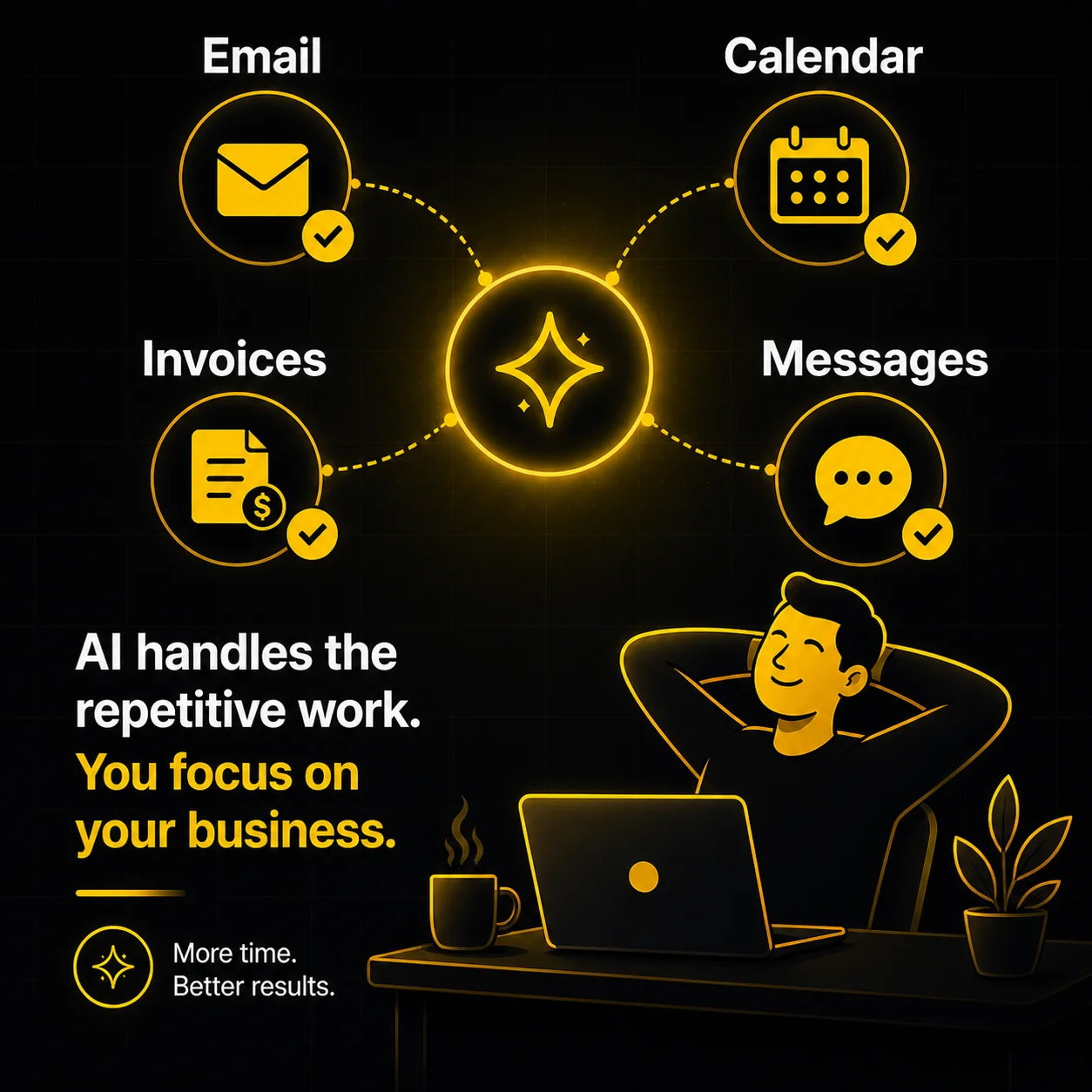
For example, imagine you want to follow up with every lead who visited your pricing page but did not book a call in the last 30 days. A chatbot cannot do that on its own. An AI agent for business could pull the list from your CRM (your customer relationship management software), draft a personalized follow up email for each contact, check your calendar for open slots, send the emails, and log the activity back in the CRM. All of that, triggered by one instruction.
Anthropic's published research on how large language models reason and plan helps explain why this multi step capability is only now becoming reliable enough for business use. The underlying models have improved significantly in their ability to break a goal into subtasks and recover when one step goes wrong.
Key traits of an AI agent:
- Works toward a goal across many steps
- Connects to outside tools and systems (email, CRM, calendars, databases)
- Makes intermediate decisions without human input at each step
- Can run on a schedule or be triggered by an event, not just a chat message
Which One Is Right for Your Business Right Now
The honest answer is that most small and mid sized businesses should be building toward both, for different purposes.
A chatbot is often the right first step. It is easier to deploy, easier to test, and delivers visible results quickly. AI customer service bots, for instance, can resolve a meaningful share of inbound questions without any staff involvement, improving customer satisfaction while reducing costs.
AI agents make sense when you have a repeatable, multi step workflow that currently eats your team's time. Strong candidates include:
- Lead nurturing sequences that depend on behavior triggers
- Competitive price monitoring and alerts
- Weekly reporting that pulls data from multiple sources
- Onboarding workflows that span email, tasks, and calendar invites
- Inventory reorder processes tied to sales velocity data
According to research from McKinsey's QuantumBlack practice, companies that move beyond simple AI automation into connected, multi step workflows see substantially larger productivity gains than those using standalone AI tools. The compounding effect of automating entire processes, rather than single tasks, is where the competitive advantage starts to show up.
The Risk of Waiting Too Long
There is a real cost to treating AI agents as a future concern. Competitors in nearly every sector are already testing agentic workflows. The businesses that build these capabilities now will have a structural speed advantage: faster follow up, lower cost per customer interaction, and more consistent execution across their operations.
The good news is that you do not need a large technical team to start. Many AI agents for business can be configured using platforms that require no coding. What you do need is a clear view of which workflows are worth automating and a thoughtful approach to making sure the agent behaves the way you intend.
That is where having the right strategic partner matters. Understanding the technology is one thing. Knowing which process to tackle first, how to connect it to your existing tools, and how to measure whether it is working, is where most businesses get stuck.
Start With a Clear Question
Before choosing between a chatbot and an AI agent, ask yourself one question: Am I trying to answer something, or accomplish something? If the goal is to answer customer questions faster, a well built chatbot delivers strong ROI quickly. If the goal is to get a multi step task done without adding headcount, an AI agent is the right tool.
Most growing businesses will eventually need both, working together. The companies that understand the difference today will build smarter, leaner operations while their competitors are still asking the same question you just answered.